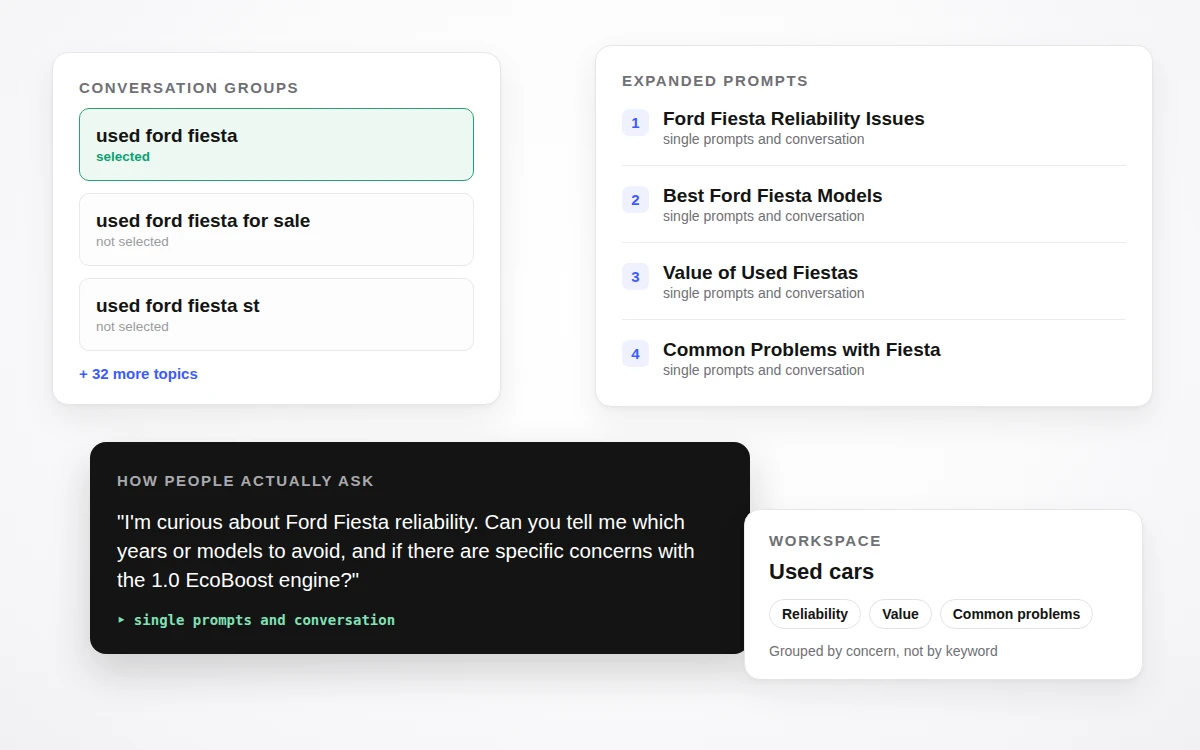
Conversation mapping is the practice of recording the real questions people ask about a subject, grouping them by the concern behind them and ordering them into the conversations people have with Google and AI assistants. The result, a conversation map, shows what people need to know, in what order, and what they are trying to decide.
Why conversation mapping matters now
For twenty years, search research meant keyword research. You found the short phrases people typed, measured how often they typed them and wrote a page for each one. That still works for Google's classic results. It does not describe how people now look for answers.
People ask AI assistants such as ChatGPT, Gemini, Perplexity and Google's AI Mode full questions, and then they ask the next one. Someone looking into pet insurance does not type "pet insurance cost" and stop. They ask what it covers, then what it does not cover, then why dental is excluded, then what to do because their dog needs dental work they cannot afford. Each answer shapes the next question, and the brands that appear along the way are the ones they end up trusting.
Conversation mapping captures that. Instead of a list of phrases, it produces the questions, the concerns that connect them and the order they come in. That is what you need to write content that answers a real person properly, and to track whether AI assistants recommend you when that person asks.
Where the term comes from
The name is not new, and it is worth knowing its history, because you will meet the older meanings in search results and in conversation.
Meetings and decision making. The longest-standing use comes from the issue-based information system (IBIS), proposed by the urban planner Horst Rittel and Werner Kunz in 1970 as a way to support groups working on hard, messy problems. IBIS breaks a discussion into issues, positions and arguments. It later became the basis of dialogue mapping, a facilitation technique in which someone records a live group discussion on a shared screen as it happens. Some writers call this conversation mapping too.
Systems thinking. Bruce McKenzie of the Systemic Development Institute used the name for a technique that brings people with different perspectives on a complex situation into one structured conversation, to build a shared model of it.
Content marketing. In 2019, an article in The Drum described conversation mapping as a workshop exercise. A team brainstorms every conversation a customer might have on the way to buying, then plans content against each step.
Outreach. Some digital PR teams use the term for planning an email or phone call in advance, with a branch for each way the contact might respond.
The version on this site. Conversation mapping here keeps the ideas that matter from each of these. It structures questions into issues, as IBIS does. It follows the customer's journey, as the content-marketing version does. The difference is the source. Instead of a workshop guessing what customers might ask, it is built from what thousands of people actually ask Google, collected from People Also Ask, cleaned and ordered. It is designed for search and for AI visibility, not for meetings.
Conversation mapping vs keyword research
The two work best together. Keyword research tells you how much demand a topic has. Conversation mapping tells you what people inside that topic actually need.
| Keyword research | Conversation mapping | |
|---|---|---|
| Unit | Short phrases ("pet insurance cost") | Full questions ("Why does pet insurance go up every year?") |
| Main measure | Monthly search volume | Which concerns exist, and how questions connect |
| Structure | A flat list, sometimes clustered | Groups by concern, each ordered into a conversation |
| Shows intent | Roughly, from the wording | Directly, with a buyer stage for every question |
| Built for | Ranking a page in Google's classic results | Answering people properly in Google and in AI assistants |
| Output you can use | Target phrases for pages | Content briefs, FAQ order and prompts for AI visibility tracking |
Conversation mapping vs dialogue mapping
Dialogue mapping records one live discussion among a group of people, usually in a meeting, and turns it into a map of issues, positions and arguments so the group can reach a decision. Conversation mapping for search records the questions asked by many separate people over many searches, and turns them into a map of what a typical customer needs to know before they decide. One helps a team think together. The other helps a business understand its customers. If you came here looking for the meeting technique, the IBIS and dialogue mapping references at the end are the place to start.
How conversation mapping works
Every map on this site is built with the same eight steps. The steps are simple to describe. Doing them well, across hundreds of questions, is where the work is.
Choose a seed subject and a market
Start from the subject a customer would actually search, such as "pet insurance", and fix the country. Questions, prices, rules and products differ by market, so a map is always for one place. The examples here are all for the UK.
Collect the questions
Search the seed and record the People Also Ask questions Google shows. Then search those questions and record the questions they open up, several levels deep. This tree of real questions is the raw material for everything that follows.
Grow the tree if it drifts
People Also Ask follows the words, not the meaning. A search for home lifts drifts into commercial elevators. A search for weight loss injections drifts into dieting. When that happens, add the subject's most searched terms as extra seeds, such as "stairlifts" or the names of the medicines, and collect again.
Remove duplicates
Many questions ask the same thing in different words. Group the near-duplicates and keep the clearest wording of each, so every question on the map is distinct.
Screen the questions
Take out anything a real customer in that market would not ask, such as questions about other countries, about one named company, or asked out of idle curiosity. What is left is the market's genuine questions.
Label each question with a buyer stage
Mark every question as discovery (learning what it is), comparison (weighing options), evidence (checking it holds up), decision (ready to choose) or ownership (already has it). The stages show where in the journey each concern sits.
Group by concern and order the conversations
Group the questions by the concern behind them, such as costs, risks or eligibility, not by shared words. Then order each group into the sequence one person would ask the questions in, ending on a decision. Where the real questions do not reach a decision, add one closing question that does.
Write the expanded prompts and review the map
For each group, write one expanded prompt that asks the whole conversation in a single message, the way someone might ask an AI assistant. Then read every group end to end as a person would, and fix anything that repeats, jumps or wanders off the concern.
Anatomy of a conversation map
Each map on this site has the same parts.
- Workspaces. The subject the map covers, with related subjects alongside it.
- Conversation groups. The search terms that make up the subject, showing which one the map was built from.
- Expanded prompts. One per concern. A single message that asks the whole conversation, ready to paste into an AI assistant.
- Single prompts. Every distinct question in the group, each labelled with its buyer stage.
- Conversations. Those questions in the order one person would ask them, ending on a decision.
A worked example
Here is one conversation from the pet insurance conversation map. The concern is making a claim. Every question is one people really ask in the UK, and the order is the order they need the answers in.
- How quickly after taking out a policy can I claim?
- How do I make a claim?
- When should I submit it?
- How long do claims take?
- Why would pet insurance not pay out?
- Is it worth making a claim?
Read as a list of keywords, these would be six separate topics. Read as a conversation, they tell a pet insurer exactly what a claims page needs to cover, in what order, and that the real worry underneath is whether a claim will be refused and push up the premium. They are also six prompts, plus one expanded prompt, that show whether ChatGPT or Gemini recommends that insurer when someone asks about claims.
What makes a good conversation map
- Every question is real. Single prompts come from what people actually asked. Only the closing question of a conversation may be written, and only when the real questions stop short of a decision.
- It is about one market. Questions about another country's rules, benefits or products are removed. A UK map does not include US health insurance terms such as copays and deductibles.
- It is about the subject, not the brands. Questions about one named company, or comparing named companies, are left out. The map describes the category, so it can be used to measure any brand within it.
- Every conversation reads as one person. No turn repeats an earlier one, and no turn belongs to a different concern.
- It stays on the subject. Wider-topic questions stay in only when the person dealing with the subject would really ask them.
- It handles sensitive subjects with care. Questions that dwell on graphic or distressing detail are removed. Practical questions about pain, safety and risk stay in.
What I learned building twelve conversation maps
The method above reads neatly. Building the twelve maps on this site was messier, and the mess is where most of the value is. These are the lessons that changed how I build them.
Everyday words send People Also Ask off course
Google's People Also Ask follows the words in a question, not what the person meant. Any subject with an everyday word in its name drifts. The first home lifts tree was mostly about commercial elevators, the biggest lift companies and elevator pitches. Weight loss injections turned into crash diets and fasting within two levels. Adjustable beds wandered into US bed sizes and whether a queen is bigger than a double. Red light therapy ended up in gum disease and sheet face masks.
The fix was the same every time. I added the category's most searched terms as extra starting points, such as stairlifts and through floor lifts for home lifts, and the medicine names for weight loss injections, then collected again. The home lifts map went from elevators to stairlift costs, NHS grants and battery replacement. Without that step the published map would have been about the wrong subject.
A UK map has to remove a lot of America
Even when searching from the UK, a large share of questions are about another country. The equity release tree was full of home equity lines of credit and reverse mortgages, which are US products. Private health insurance brought in copays, coinsurance and deductibles, which UK policies do not use. Riser recliner chairs came with Medicare and tax deduction questions. Weight loss injections included Zepbound, the US name for a medicine sold differently in the UK.
None of these belong on a UK map, and they are easy to miss because they sound relevant. A map that answers a UK customer with American products is worse than no map at all.
Brand rules need judgement, not a word list
I remove questions about single named companies so the map describes the market, not one brand in it. Applying that rule automatically went wrong in both directions. An automated check removed "Who is the best equity release company in the UK?" and "Which equity release companies should I avoid?" as brand questions, although they name no brand and are two of the most useful questions in the subject. At the same time, Mounjaro and Wegovy are capitalised names but they are the medicines people are researching, not companies selling them. SMILE is a laser eye procedure, not a clinic.
The working rule became simple to state and harder to apply. A question stays out if it names a provider or compares named providers. It stays in if it asks which provider is best without naming one, or if the name is the product or treatment itself.
Automated grouping produces lists, not conversations
Letting software choose the order of questions in a conversation produced groups that looked tidy and read badly. One early funeral plans conversation asked who the best funeral plan provider is, then which company is best for funeral insurance, then what the top ten funeral plans are. That is the same question three times, followed by a question about choosing a funeral director that belonged somewhere else.
Every conversation on this site is now ordered by hand, with a reason for the order, and read aloud as one person before it is published. It is the slowest part of the work and the part that makes the maps useful.
Sensitive subjects need a person, not a filter
Funeral plans, weight loss injections, hair transplants and laser eye surgery all involve bodies, pain or loss. An automated check for distressing content removed practical questions such as "Is FUE hair transplant painful?", "Do they put a needle in your eye?" and "Can Mounjaro cause pancreatitis?", which are exactly what a nervous customer needs answered. It also let through questions that dwelt on graphic physical detail with no practical purpose.
The line I use is whether the answer helps someone decide or cope. Pain, safety and risk questions stay. Questions asked out of morbid curiosity go.
The closing question matters most for AI search
Real questions often stop before a decision. People ask what equity release costs and how the interest works, but the conversation they are having is about whether to go ahead. Ending each conversation on that decision, such as "Is equity release worth it at today's rates?" or "Should I have my hair transplant in the UK or abroad?", turns the map into the prompts that matter for AI visibility. That is the moment an assistant names a provider, and the moment a brand either appears or does not.
Every industry has a conversation people are really having
Each map also showed something about its market that a keyword list would not.
- Pet insurance. The coverage conversation runs from what a policy covers to why dental treatment is so often excluded, and ends with an owner whose dog needs dental work they cannot afford.
- Hair transplants. UK patients ask about the cost of grafts in the UK and in Turkey side by side. Where to have the procedure is part of the price decision, not a separate topic.
- Private health insurance. Many questions are really about the NHS, such as whether going private is faster and whether you can see a consultant privately then have treatment on the NHS.
- Home lifts and stairlifts. Funding sits alongside price. Who is entitled to a free stairlift and whether the NHS will help are as prominent as what a lift costs.
- Weight loss injections. Stopping is a conversation of its own. People ask why others stop, how to come off the medicine and how to keep the weight off afterwards.
- Funeral plans. The map covers two very different people: someone planning ahead for themselves, and someone arranging a funeral for a husband or parent who has just died.
How to use a conversation map
SEO content planning. Each conversation group is a content brief. The group title is the topic, the single prompts are the questions the page must answer, and the conversation order is the order a reader needs the answers in. Any group with no matching page on your site is a content gap.
GEO and AI visibility. The expanded prompts and conversations are realistic prompts for generative engine optimisation. Run them in ChatGPT, Gemini, Perplexity and Google AI Mode to see which brands and sources each assistant cites for each concern. That shows where you are visible, where competitors are, and what to create to be cited.
FAQs and help content. The single prompts, in buyer-stage order, are a ready-made FAQ that matches how customers think, rather than how the business is organised.
Digital PR. A map shows what people worry about most. "The questions UK pet owners ask before buying insurance" is a story, and the map is the data behind it.
Sales and customer service. The conversations show the questions a prospect is likely to ask next, and the decision they are working towards.
Example conversation maps
Twelve conversation maps, each built from UK People Also Ask data with the method above. Each one is a complete landscape for its subject, with expanded prompts, single prompts and full conversations.
Money and insurance
Health
Home accessibility
Common mistakes
- Trusting the tree without reading it. People Also Ask drifts. Always check that the questions are still about the subject before you group them.
- Grouping by shared words. "Pet insurance cost" and "pet insurance claim" share words but not a concern. Group by what the person is worried about.
- Keeping near-duplicates in a conversation. "Who is the best provider?" followed by "Which company is best?" is one question asked twice. Keep the clearest one.
- Letting brands in. A map full of one company's name tells you about that company, not the market.
- Ending without a decision. A conversation that stops at a fact has not reached the point where people choose. That point is where AI recommendations matter most.
- Mixing markets. One US question about Medicare or HELOCs makes a UK map less useful and less trustworthy.
Questions about conversation mapping
What is a conversation map?
A conversation map is the output of conversation mapping. It shows the questions people ask about one subject, grouped by the concern behind them, with each group written up as one expanded prompt, the single prompts that make it up, and an ordered conversation that follows one person from their first question to a decision.
How is conversation mapping different from keyword research?
Keyword research measures how often short phrases are searched. Conversation mapping records the full questions people ask, the order they ask them in and the concern that connects them. Keyword research tells you what to target. A conversation map tells you what to answer, in what order, and what the person is trying to decide.
Is conversation mapping the same as dialogue mapping?
No. Dialogue mapping is a meeting facilitation technique that records a live group discussion as issues, positions and arguments, using the IBIS notation. Conversation mapping for search records what customers ask across many searches and AI conversations, not what one group says in one meeting. The two share a name and a love of structure, but they answer different questions.
How do you create a conversation map?
Start from a seed subject, collect the questions people ask (People Also Ask is the best free source), remove duplicates and questions about other countries or named brands, label each question with a buyer stage, group the questions by concern, order each group into a conversation, and write one expanded prompt per group. The method section above sets out every step.
How many questions does a conversation map need?
Enough to show every concern people have. A consumer subject usually needs a few hundred distinct questions before every concern appears. With too few, whole concerns go missing and the map looks simpler than the market really is.
How is a conversation map used for GEO and AI visibility?
The expanded prompts and conversations are realistic prompts to run in ChatGPT, Gemini, Perplexity and Google AI Mode. Running them shows which brands and websites AI assistants cite for each concern, which is the basis of AI visibility tracking and of deciding what content to create so you are cited.
How is a conversation map used for SEO?
Each conversation group is a natural content brief. The group title is a topic, the single prompts are the questions the page must answer, and the conversation order is the order a reader needs the answers in. Groups with no matching page on your site are content gaps.
How often should a conversation map be updated?
Review it every six to twelve months, or sooner when the market changes. People Also Ask results change as products, prices and rules change, and a map built before a change will miss the questions that follow it.
Can I use conversation mapping for my own industry?
Yes. The method works for any subject people research before they buy or decide, and it works best for considered purchases where people ask many questions first. The twelve examples on this page cover finance, health and home accessibility.
References
- Rittel, H. and Kunz, W. (1970). Issues as Elements of Information Systems. Working Paper 131, Institute of Urban and Regional Development, University of California, Berkeley.
- Issue-based information system. Wikipedia.
- Conversation mapping (meeting method and IBIS). IdeaScale.
- McKenzie, B. Conversation Mapping. Systemic Development Institute, via Cognitive Edge.
- A beginners' guide to conversation mapping. The Drum, 27 March 2019.
- How conversation mapping can boost your outreach success rate. Found.
- Google Search: People Also Ask results, collected for each landscape on this site through DataForSEO.